

Polyaspartic Floor Coatings in the Inland Empire
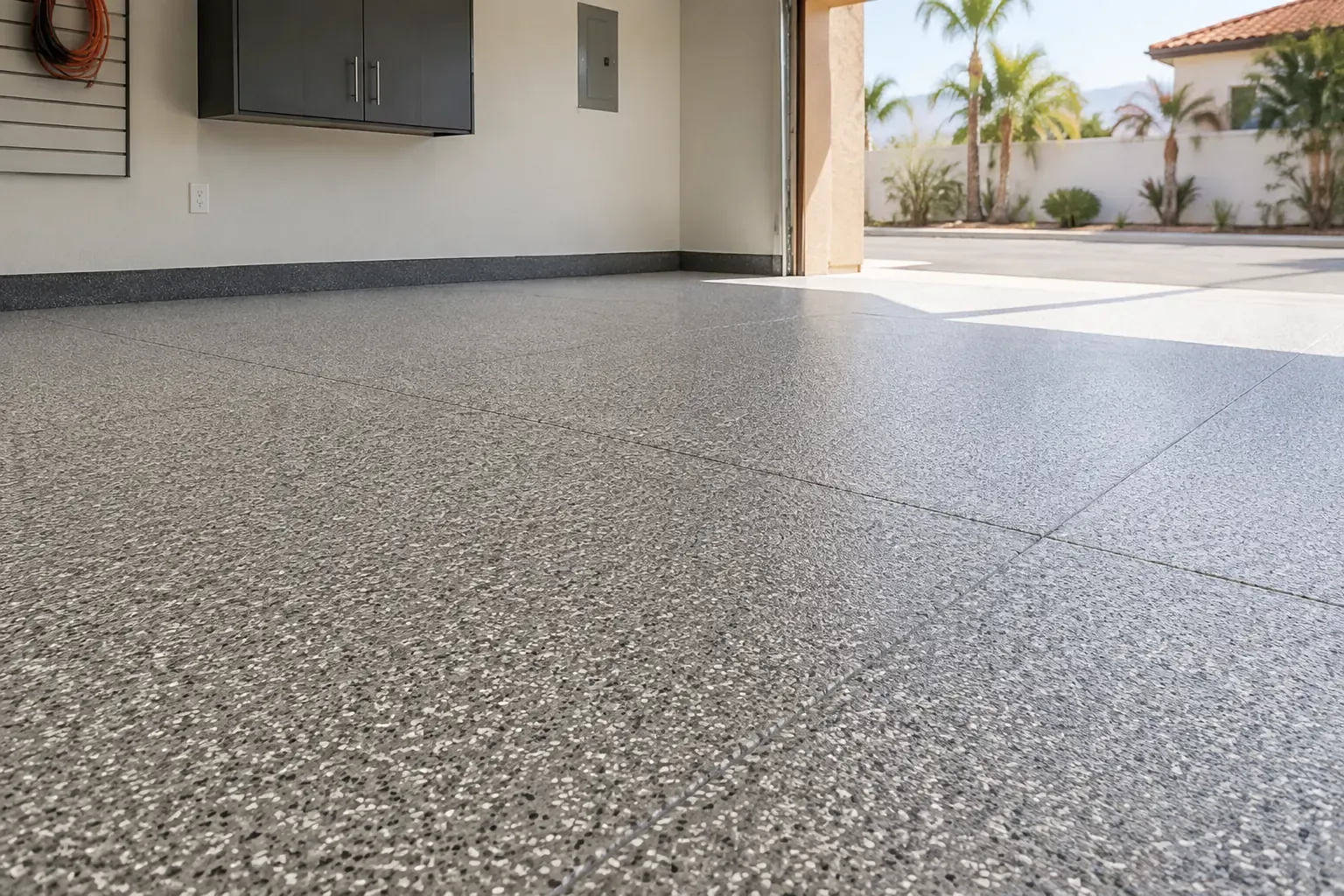
When a garage or shop cannot sit empty for a week, polyaspartic is the answer. It is the fastest-curing, most UV-stable coating we install, and demand for it keeps growing across the Inland Empire for good reason. Here is what it is, how it performs in Southern California conditions, and when it earns its premium over epoxy.
What Polyaspartic Actually Is
Polyaspartic is an aliphatic polyurea — a coating chemistry originally developed in the 1990s to protect steel bridges from corrosion. Flooring formulations take that same toughness and tune it for concrete: high abrasion resistance, strong chemical resistance and a glass-clear finish that stays clear for the life of the floor.
Two working traits set it apart. It cures fast, so a complete system can often go down in a single day. And it is UV-stable, which matters more here than in most of the country. Like any coating, though, it is only as good as the surface beneath it. We grind every slab to the right profile before a drop of material goes down — our guide on why surface preparation matters explains what that involves.
Back in Service in About a Day
Standard epoxy needs several days to reach full cure. Polyaspartic reaches walk-on hardness in hours, and most floors can take vehicle traffic in as little as 24 hours. For a household that parks two cars in the garage every night, or a business that cannot close for a week, that single difference often decides the project.
Fast cure has a flip side: short working time. Polyaspartic starts setting quickly once mixed, so the crew has to move with purpose — mixing in small batches, keeping a wet edge and broadcasting flake on schedule. It is not a forgiving material for first-timers, which is exactly why it goes down by trained crews rather than out of weekend kits.
No Yellowing by the Sunny Garage Door
Southern California sun is hard on coatings. Standard epoxy can amber where direct light hits it — and in this region, light hits it. Foothill cities like Upland and Rancho Cucamonga get intense sun most of the year, and a west-facing garage door left open on summer evenings bathes the first few feet of floor in UV day after day.
Polyaspartic is UV-stable. The clear coat will not yellow at the threshold, by the door or anywhere else, so the floor keeps its color from the back wall to the driveway edge. If your garage door faces the sun, or you like working with the door up, that stability alone can justify the upgrade.
Handles Inland Empire Temperatures
Summer highs here routinely push past 100 degrees, and garage slabs get hotter still. Polyaspartic can be formulated for a wider installation temperature range than epoxy, which lets us coat through hot summer weeks and cool winter mornings that would put an epoxy pour on hold. Once cured, it stays hard in the heat and flexible enough to ride out the swing between a scorching afternoon and a cool desert-edge night without stress.
The Hybrid System: Epoxy Base, Polyaspartic Top
You do not have to pick one chemistry for the whole floor. Many of the floors we install are hybrids: an epoxy base coat for build and adhesion, a full flake broadcast for color and texture, and a polyaspartic topcoat as the wear surface. The epoxy does what epoxy does best — penetrating and building on properly ground concrete — while the polyaspartic contributes UV stability and abrasion resistance where the floor actually takes its punishment.
Hybrids also trim the price compared with a full polyaspartic build, because the premium material goes only where it earns its keep. Our side-by-side comparison of the two chemistries covers the trade-offs in more depth.
When Polyaspartic Is Worth the Premium
Polyaspartic costs more than epoxy — there is no way around the material price. It is worth paying when:
- You need the space back fast. Next-day return to service versus most of a week.
- The slab sees sunlight. Sunny thresholds, entries and patios that would slowly amber an epoxy finish.
- The floor works hard. Hot tires, jack stands and cart wheels wear through lesser topcoats first.
- The calendar will not cooperate. A wider installation window keeps projects moving in weather that sidelines epoxy.
If the floor lives indoors, budget leads, and you can give the space up for a few days, epoxy remains a strong value — and we will tell you so. Material is only part of any quote; our breakdown of what drives the cost of a coated floor shows where the money actually goes.
Get an Honest Recommendation
Whether you are weighing polyaspartic for a garage in Chino Hills, a shop floor or a commercial space anywhere in the Western Inland Empire, we will look at your concrete, talk through how you use the space and spec the system honestly — hybrid, full polyaspartic or straight epoxy. The estimate is free, and there is no pressure attached.
Polyaspartic Floor Coatings Questions
How soon can I drive on a new polyaspartic floor?
Most polyaspartic floors accept foot traffic within hours and vehicle traffic in as little as 24 hours, depending on temperature and the system installed. We confirm cure timing with you before we finish so there is no guesswork.
Will polyaspartic yellow near a sunny garage door?
No. Polyaspartic is an aliphatic, UV-stable chemistry, so it will not amber or yellow in direct sunlight the way standard epoxy can — a real advantage for sun-exposed garage thresholds in Southern California.
Is a full polyaspartic system always better than a hybrid?
Not always. A hybrid system — epoxy base, flake broadcast, polyaspartic topcoat — puts the UV-stable, high-wear material where it matters most and often costs less than polyaspartic top to bottom. We recommend whichever fits your slab, timeline and budget.
Can polyaspartic be installed in summer heat or winter cold?
Yes, within limits. Polyaspartic tolerates a wider installation temperature range than epoxy, so we can work through Inland Empire summers and cool winter mornings. Very hot slabs shorten the working time, so we schedule and mix accordingly.
Can you apply polyaspartic over my existing epoxy floor?
Sometimes. If the existing coating is well bonded, we can abrade it and finish it with a polyaspartic topcoat. If it is peeling or was never properly prepped, it needs to come off first — we assess that during your estimate.
Where We Install
We install polyaspartic floor coatings throughout the Western Inland Empire.
Ready to Upgrade Your Concrete?
Let's create a floor that looks incredible and stands up to real life.